Expert Systems
Expert Systems in AI: Architecture, Components, and How LLMs Are Transforming Them
Integration of rule-based expert systems with modern LLMs, combining symbolic reasoning and neural intelligence.Expert systems are a pivotal branch of artificial intelligence (AI), designed to emulate the
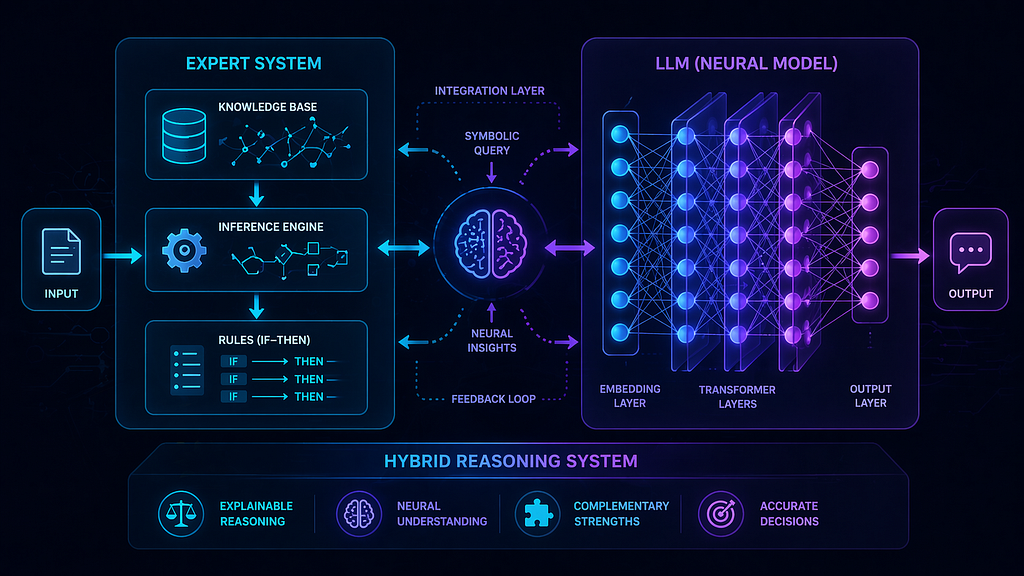
Integration of rule-based expert systems with modern LLMs, combining symbolic reasoning and neural intelligence.
Expert systems are a pivotal branch of artificial intelligence (AI), designed to emulate the decision-making abilities of human experts. They tackle complex problems by reasoning through bodies of knowledge, primarily represented as if-then rules, rather than relying on conventional procedural code. This article delves into the core components, architecture, development process, and the evolving integration of Large Language Models (LLMs) in expert systems.
Core Components of Expert Systems
An expert system comprises three fundamental components:
Knowledge Base: This repository stores domain-specific facts and heuristics. It encompasses both factual knowledge (based on accepted facts) and heuristic knowledge (derived from experience and practice). The richness of the knowledge base directly influences the system’s precision.
Inference Engine: Often termed the system’s “brain,” the inference engine applies logical rules to the knowledge base to deduce new information or reach conclusions. It employs reasoning strategies like forward chaining (data-driven) and backward chaining (goal-driven) to process information.
User Interface: This component facilitates interaction between the user and the expert system, allowing users to input queries and receive explanations or solutions in a comprehensible format.
Overall Architecture of Expert Systems
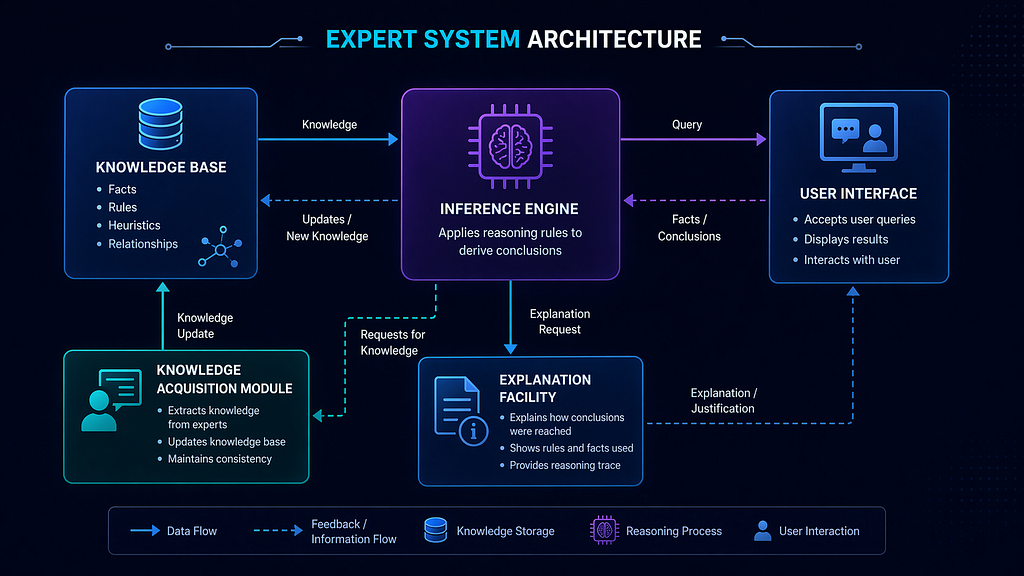
High-level architecture of an expert system and how its core components interact.
The architecture of an expert system integrates its core components to function cohesively:
Knowledge Acquisition Module: Gathers and updates information from domain experts to enrich the knowledge base.
Explanation Facility: Provides users with insights into the reasoning process, detailing how specific conclusions were reached.
Knowledge Base: Stores structured information, often organized into classes, subclasses, and instances, facilitating efficient retrieval and application.
Inference Engine: Processes the knowledge base using reasoning strategies to derive conclusions.
User Interface: Enables seamless communication between the user and the system.
This modular design ensures that each component plays a distinct role, contributing to the system’s overall efficacy.
Process of Developing an Expert System
Building an expert system involves several critical steps:
Knowledge Acquisition: Collecting domain-specific information from human experts.
Knowledge Representation: Structuring the acquired knowledge into a formalism, such as if-then rules, suitable for processing by the inference engine.
Implementation: Integrating the knowledge base with the inference engine and user interface to create a functional system.
Testing and Validation: Ensuring the system’s accuracy and reliability by comparing its outputs against expert judgments.
Maintenance: Regularly updating the knowledge base to reflect new information and refining the system based on user feedback.
This systematic approach ensures the development of robust and reliable expert systems.
Role of the Inference Engine in Expert Systems
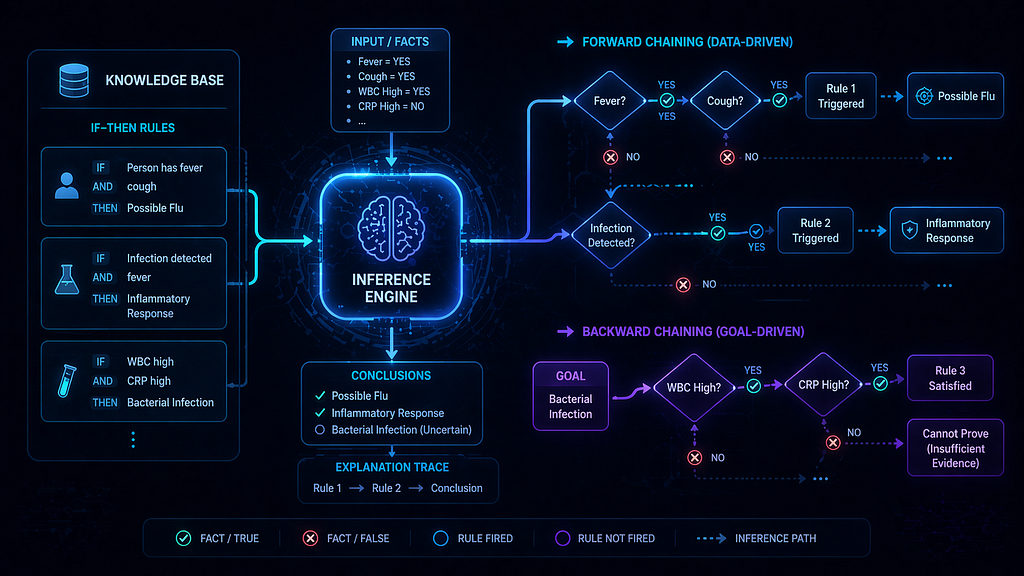
Inference engine applying rule-based reasoning to derive conclusions from structured knowledge
The inference engine is central to an expert system’s functionality. It applies logical rules to the knowledge base to derive conclusions or make decisions. By employing reasoning strategies like forward and backward chaining, the inference engine processes information efficiently, ensuring accurate and relevant outputs.
The First Expert System
One of the earliest expert systems was MYCIN, developed in the 1970s at Stanford University. Designed to diagnose bacterial infections and recommend antibiotics, MYCIN utilized a rule-based approach to emulate the decision-making process of medical experts. Despite its success in demonstrating the potential of expert systems, MYCIN was not widely adopted in clinical practice due to ethical and practical considerations.
Building Domain-Specific Expert Systems
Developing an expert system tailored to a specific domain involves:
Identifying the Domain: Selecting a specialized area where expert knowledge is essential.
Gathering Expertise: Collaborating with domain experts to acquire relevant knowledge.
Designing the Knowledge Base: Structuring the acquired knowledge into a formal representation.
Implementing the Inference Engine: Choosing appropriate reasoning strategies to process the knowledge.
Developing the User Interface: Creating an intuitive interface for user interaction.
Testing and Refinement: Validating the system’s performance and making necessary adjustments.
This process ensures the creation of expert systems that effectively address domain-specific challenges.
Real-Life Examples and Case Studies of Expert Systems
Expert systems have been applied across various industries:
Medical Diagnosis: Systems like MYCIN assist in diagnosing diseases and recommending treatments.
Financial Services: Expert systems evaluate loan applications and manage investment portfolios.
Manufacturing: They monitor processes and diagnose equipment faults to enhance efficiency.
These applications demonstrate the versatility and impact of expert systems in solving complex, domain-specific problems.
Integrating Large Language Models (LLMs) with Expert Systems
The integration of Large Language Models (LLMs) into expert systems marks a significant advancement in artificial intelligence, enhancing the capabilities and applications of these systems.
Integrating Large Language Models (LLMs) with Expert Systems
LLMs, such as OpenAI’s GPT-4, have the potential to enhance expert systems by improving natural language understanding and generation. This integration can lead to more intuitive user interactions and the ability to process unstructured data effectively. For instance, in the legal domain, LLMs have been utilized to automatically extract structured representations from legislation, thereby supporting the development of legal expert systems. A study demonstrated that 60% of the generated pathways were rated as equivalent or better than manually created ones, indicating the efficacy of LLMs in this context.
Importance of LLMs in Expert Systems
The incorporation of LLMs into expert systems offers several benefits:
1. Enhanced Text Classification: LLMs can serve as effective text classifiers, simplifying traditional workflows by reducing the need for extensive preprocessing and domain expertise. Research has shown that certain LLMs outperform traditional methods in tasks such as sentiment analysis and spam detection.
2. Improved Knowledge Representation: LLMs can assist in encoding complex texts into structured formats, facilitating the creation of more robust knowledge bases. This capability is particularly valuable in domains like law, where legislation needs to be translated into formal representations for expert systems.
3. Cost Efficiency: Integrating LLMs can reduce the time and resources required for knowledge acquisition and system development, as these models can process and interpret large volumes of data efficiently.
Substitutes for Expert Systems in the Current Scenario
While expert systems have been instrumental in various applications, alternative approaches have emerged:
Case-Based Reasoning (CBR): This method solves new problems by referring to similar past cases, making it suitable for domains where historical cases are available. CBR is particularly effective in complex domains with numerous ways to generalize a case.
Neurosymbolic AI: Combining neural networks with symbolic reasoning, this approach aims to leverage the strengths of both methodologies. Recent advancements have shown promising improvements in tasks that are challenging for traditional AI models.
Open-Source AI Models: The rise of open-source AI models offers customizable and cost-effective alternatives to proprietary expert systems. Companies are increasingly adopting these models for various business tasks, broadening the AI knowledge pool among engineers.
In conclusion, the integration of LLMs into expert systems enhances their capabilities, making them more efficient and versatile. However, alternative approaches like case-based reasoning, neurosymbolic AI, and open-source models provide viable substitutes, each with unique advantages in addressing complex problems in the current AI landscape.
Expert Systems in AI: Architecture, Components, and How LLMs Are Transforming Them was originally published in GoPenAI on Medium, where people are continuing the conversation by highlighting and responding to this story.