NLP
How RAG Eliminates AI Hallucinations (Step-by-Step Guide for Beginners)
From hallucination to truth — how Retrieval-Augmented Generation grounds AI in reality.As artificial intelligence continues to evolve, large language models (LLMs) have become increasingly popular for solving real-world
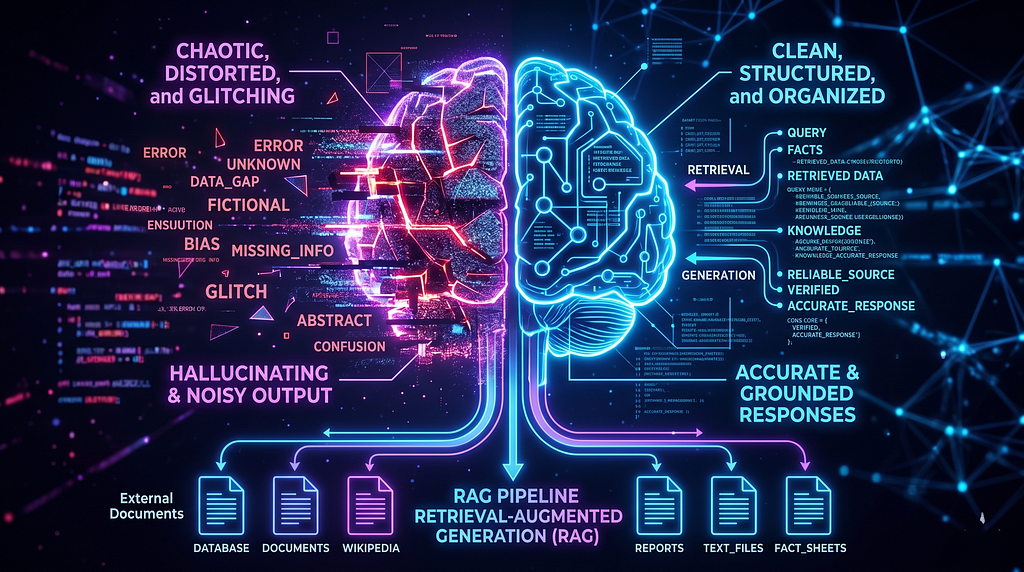
From hallucination to truth — how Retrieval-Augmented Generation grounds AI in reality.
As artificial intelligence continues to evolve, large language models (LLMs) have become increasingly popular for solving real-world problems. However, while LLMs can generate impressive responses, they are far from perfect. They often struggle with consistency, lack real-world awareness, and sometimes produce misleading or fabricated information—a phenomenon known as “hallucination.” This is where Retrieval-Augmented Generation (RAG) comes into play, revolutionizing how we ground AI models on accurate, up-to-date information while maintaining transparency.
What Is Retrieval-Augmented Generation (RAG)?
Understanding RAG in Simple Terms
Think of RAG as giving an AI system an “open book” to answer your questions instead of relying solely on its memory. While LLMs like GPT-4 or others are trained on massive datasets, they sometimes hallucinate, i.e., generate incorrect or imaginary responses. RAG tackles this limitation by retrieving accurate and up-to-date information from external knowledge bases before generating a response.
Definition
Retrieval-Augmented Generation (RAG) is an advanced AI framework that enhances the performance of LLMs by integrating external knowledge bases. Instead of relying solely on pre-trained data baked into an LLM’s parameters, RAG retrieves relevant information from reliable, external sources to supplement the model’s internal knowledge.
In essence, RAG turns a closed-book exam into an open-book one, allowing the model to “browse” through external resources for accurate answers rather than relying solely on memory. This framework significantly reduces the risk of misinformation, makes responses more reliable, and enhances transparency by linking the answers to their sources.
Why Do LLMs Need RAG?
LLMs are built using vast datasets and trained on statistical relationships between words, not their actual meanings. While this allows them to generate fluent responses, it often leaves them disconnected from real-world contexts. For example:
LLMs may provide outdated or inaccurate information if they haven’t been updated recently.
They might hallucinate facts, creating plausible-sounding but incorrect answers.
Sensitive or confidential information stored within the model’s parameters might inadvertently leak.
RAG addresses these challenges by grounding the model’s outputs on verifiable external data sources, enabling more precise and trustworthy interactions.
How Does RAG Work?
The RAG framework operates in two primary phases:
1. Retrieval Phase:
Algorithms search through an external knowledge base (e.g., company policies, indexed web documents, or research papers) to extract snippets of information relevant to a user’s query. These facts are appended to the user’s input to provide context.
2. Generative Phase:
The augmented input, which includes both the user’s prompt and the retrieved facts, is passed to the LLM. The model then synthesizes a response by combining its internal knowledge with the external data. The final response may also include links to the sources for added transparency.
For example, in an enterprise setting, RAG could retrieve specific company policies or HR documents to answer a personalized employee query like, “Can I take half-day vacations?” It ensures the response is both accurate and relevant.
Benefits of RAG
RAG offers several advantages that make it a game-changer for AI enthusiasts, tech professionals, and businesses:
1. Improved Accuracy:
By relying on up-to-date and verifiable data, RAG minimizes the chances of incorrect or outdated responses.
2. Enhanced Transparency:
Users can cross-reference the model’s answers with the retrieved data sources, building trust in the system.
3. Reduced Hallucinations:
Grounding the model on external knowledge limits its reliance on potentially flawed internal parameters.
4. Lower Costs:
Instead of retraining the entire model with new data, users can simply update the external knowledge base, reducing computational and financial overhead.
5. Data Privacy:
RAG minimizes the risk of sensitive data leaks by reducing dependency on pre-trained parameters.
Real-World Applications of RAG
RAG is not just a theoretical framework—it is already transforming how businesses and organizations deploy AI:
Customer Support Chatbots:
Modern chatbots powered by RAG provide personalized answers grounded in real-time information, ensuring accuracy and relevance.
Enterprise Knowledge Management:
Companies use RAG to manage internal documentation, enabling employees to retrieve precise information on policies, workflows, or HR guidelines.
Dynamic AI Systems:
RAG allows AI models to handle highly specific, ever-changing queries by accessing external knowledge without requiring frequent retraining.
Challenges and Future of RAG
While RAG is a significant advancement, it is not without challenges:
Efficient Retrieval:
Ensuring that the right data is fetched quickly and accurately is a complex task, particularly in large-scale applications.
Optimal Generation:
Structuring retrieved information in a way that enhances the model’s response quality is still an area of active research.
Ambiguity Handling:
Models need better training to recognize when they lack sufficient information and gracefully handle such scenarios.
Despite these hurdles, RAG represents the cutting edge of AI innovation, offering a path toward more reliable, cost-effective, and transparent language models.
Building Your Own RAG Applications
For developers and businesses looking to leverage RAG, AI toolkits are making it easier than ever to get started. These tools provide resources for integrating RAG into various workflows, from building AI-powered chatbots to deploying enterprise-grade knowledge systems.
With RAG, the future of AI is not only more intelligent but also more grounded, ethical, and efficient. As this technology evolves, it will continue to bridge the gap between generative AI and real-world applications, empowering AI enthusiasts, tech students, and professionals to unlock the full potential of artificial intelligence.
Explore the possibilities of RAG and bring your AI projects to life.
A Real-World Scenario to Bring RAG to Life
Imagine you’re managing a customer-care chatbot for an international airline. A passenger, Sarah, sends a query:
“I missed my flight due to a delay in connecting flights. What are my compensation rights?”
Without RAG, the LLM might generate an incomplete or incorrect response based on outdated airline policies baked into its training data. It could say:
“Sorry for the inconvenience. Please contact customer care for assistance.”
Now let’s apply RAG:
1. Retrieval Phase: The AI retrieves the latest compensation policies from the airline’s internal database, regulations by the Department of Transportation (DOT), and international travel guidelines.
2. Generation Phase: The AI integrates the retrieved policies and provides Sarah with a clear, detailed response:
“According to our policy, passengers affected by missed connections due to delays are eligible for meal vouchers and hotel accommodations. You are also entitled to a reimbursement if the delay exceeds 8 hours. Please visit [link] for a claim submission form.”
Additionally, the chatbot provides links to the retrieved sources, boosting transparency and user trust.
Conclusion
Retrieval-Augmented Generation is paving the way for a new era of AI—one that combines the creativity of LLMs with the precision of verified information. Whether it’s solving customer queries, enabling better decision-making in enterprises, or offering personalized experiences, RAG is a game-changer.
As AI enthusiasts, students, and professionals, embracing RAG can help you stay at the forefront of AI innovation, ensuring the tools we create are as trustworthy as they are intelligent. Are you ready to build the future with RAG?
By
Gaurav Kumar
Junior Research Fellow
Institute of Artificial Intelligence
Dev sanskriti vishwavidyalaya, Uttrakhand
Query —gauravkumarsony08@gmail.com
How RAG Eliminates AI Hallucinations (Step-by-Step Guide for Beginners) was originally published in Artificial Intelligence in Plain English on Medium, where people are continuing the conversation by highlighting and responding to this story.