XML Schema
XML Is Everywhere — You Just Never Noticed It
XML Is Everywhere — You Just Never Noticed ItThe invisible language that quietly runs the internet, healthcare, banking, and your favourite apps.You’ve probably never thought about what happens the moment your doctor’s
The invisible language that quietly runs the internet, healthcare, banking, and your favourite apps.
You’ve probably never thought about what happens the moment your doctor’s clinic sends your blood report to a hospital across town. Or when your bank reconciles 30 different systems overnight. Or when a news article from Reuters lands on 500 different platforms in milliseconds — perfectly formatted every time.
There is a reason why all of that is happening. And it has been doing it since 1998.
That something is XML.
Let’s start with a simple question
Think about shifting to another city. You put everything you own in boxes. The problem is that the boxes have no labels. No one knows what is in there. Things get crazy.
<box>
  <contents>Books</contents>
  <fragile>Yes</fragile>
  <weight>12kg</weight>
</box>Suddenly, anyone — your movers, your new landlord, even a stranger — can understand exactly what’s inside. No confusion. No lost items.
That is essentially what XML does. It wraps data in labels so any computer system, anywhere in the world, can understand it.
So What Exactly Is XML?
XML stands for “eXtensible Markup Language.”
Basically XML is designed to store and share data between different systems. It is a markup language that uses tags to give plain text structure and meaning. But this is what sets it apart from HTML (which you might have heard of):
- HTML tells a web browser how to show data — like putting an image here and making text bold there.
- XML tells any system what the data means — this is a
, this is a <customer_name>, this is a .
According to the World Wide Web Consortium (W3C), which governs XML:
XML is a simple, very flexible text format originally designed to meet the challenges of large-scale electronic publishing — and now playing an increasingly important role in the exchange of a wide variety of data on the Web and elsewhere.
And from Wikipedia’s XML entry:
XML sets rules for how to encode documents so that both people and computers can read them.
That last part — human-readable and machine-readable — is what makes XML genuinely special.
A Quick Look at What XML Actually Looks Like
Here’s a simple XML document. Read it top to bottom — you don’t need any technical knowledge:
<patient>
  <name>Gaurav Kumar</name>
  <age>25</age>
  <bloodtype>AB+</bloodtype>
  <diagnosis>Hypertension</diagnosis>
</patient>That’s the power of XML’s self-descriptive nature. The data tells you what it is. A tag like
Where Did XML Come From? (The Short History)
To understand why XML was created, you need to understand the mess that existed before it.
In the early days of the internet, every company built their own proprietary format for storing data. A hospital used one format, an insurance company used another, a government database used a third. These systems could not “talk” to each other — like people from different regions speaking completely different languages without a translator.
The roots go back to the 1970s. According to the O’Reilly book XML in a Nutshell:
XML is a descendant of SGML, the Standard Generalized Markup Language, invented by Charles F. Goldfarb, Ed Mosher, and Ray Lorie at IBM in the 1970s, and developed until its eventual adoption as ISO standard 8879 in 1986.
SGML was powerful but deeply complex — used mainly by the military and aerospace sectors. It needed to be simplified for the everyday internet world.
In the late 1990s, a working group at the W3C — including Jon Bosak, Tim Bray, and James Clark — simplified SGML and released XML 1.0 as an official standard in February 1998.
As noted by Toptal’s deep-dive into XML history:
The Problem XML Was Built to Solve :
Here’s the real-world problem, put simply:
Before XML, when two different computer systems needed to share data, someone had to custom-build a “translator” between them — every single time.
- Hospital A uses System X. Insurance Company uses System Y. No sharing possible.
- A bank has 30 internal departments, each with their own data format. A unified view? Impossible.
- A news agency wants to publish to 200 different platforms. Each platform needs a different format? Nightmare.
XML solved this by creating one universal language that any system could read, regardless of who built it, what operating system it runs on, or what programming language it uses.
From the IETF’s RFC 3470 (official internet protocol documentation):
XML provides both logical and physical structure to describe data. XML instances can be validated against the formal definition of a protocol specification. XML supports internationalization and is extensible.
How XML Works — The 5 Minute Explanation
You don’t have to be a developer to understand. The core concept is:
1. Elements (Tags)
Every piece of data is wrapped in an opening and closing tag:
2. Hierarchy (Nesting)
Tags can live inside other tags — like dolls:
<employee>
  <name>Priya</name>
  <department>Finance</department>
  <salary>85000</salary>
</employee>3. Attributes
You can add extra info inside the opening tag itself:
<product id="A123" category="Electronics">
  <name>Laptop</name>
</product>4. Self-Describing
The tag names YOU choose tell other systems what the data means. Unlike a spreadsheet column that’s just “Column C,” an XML tag like <invoice_date> is unambiguous.
5. Validation (Rules)
XML documents can be checked against a “schema” — a rulebook that says what tags are allowed, what data types they should contain, and how they must be structured. This is done using DTD (Document Type Definition) or XSD (XML Schema Definition).
Think of a schema as an XML document’s constitution — it defines what’s legal and what isn’t.
Real-Life Use Cases — Where XML Lives Today
This is where it gets genuinely fascinating.
Healthcare — Your Medical Records
Every time a doctor sends your records to a specialist, or a hospital bills your insurance company, XML is likely carrying that data.
The HL7 (Health Level 7) and FHIR standards — which govern how clinical data moves between hospitals, labs, and insurers — are built on XML. As ScienceDirect notes:
XML’s portability across different platforms makes it ideal for representing data in distributed systems, overcoming heterogeneity.
Banking & Finance
After the 2008 financial crash, regulators demanded that banks produce a comprehensive view across 20–30 different internal systems — systems that didn’t speak the same language. As Progress Software’s industry analysis explains:
The banking industry had come to rely on relational technology — but now they needed to answer questions that were “to be determined.” XML offered the flexibility to define each record independently. Projects that had been in the works for years with no real progress were suddenly getting done in months.
Financial standards like FpML (Financial Products Markup Language) and XBRL (for financial reporting) are XML-based and used by stock exchanges and regulators globally.
The Internet — Web Services & APIs
When your app talks to a server, that data exchange often happens via SOAP (Simple Object Access Protocol) — which uses XML as its message format. As Medium’s own tech writers have noted:
XML serves as a standard data format for exchanging information between different systems. This makes communication and interoperability easy.
News & Publishing
Ever wonder how a news article published by Reuters instantly appears on hundreds of different news platforms — correctly formatted every time?
XMLNews is a specification for exchanging news and other information. Using a standard makes it easier for both news producers and consumers to produce, receive, and archive any kind of news information across different hardware, software, and programming languages.
Your Microsoft Office Files
Open a MS Word (.DOCX) file — it’s actually a ZIP archive containing XML files inside. Microsoft built the entire modern Office format on XML. Every paragraph, heading, table, and image in your document is stored as XML.
Android Apps
There is an AndroidManifest.xml file in every Android app. It’s XML. It tells the phone about the app, what permissions it needs, and how it should behave.
Maps & Science
Geographic data, weather forecasting systems, and scientific research rely on XML. Meteorological information exchange systems like IWXXM are XML-based — allowing weather data from one country to be instantly understood by systems in another.
The Key Benefits of XML
Let’s keep this simple and concrete:
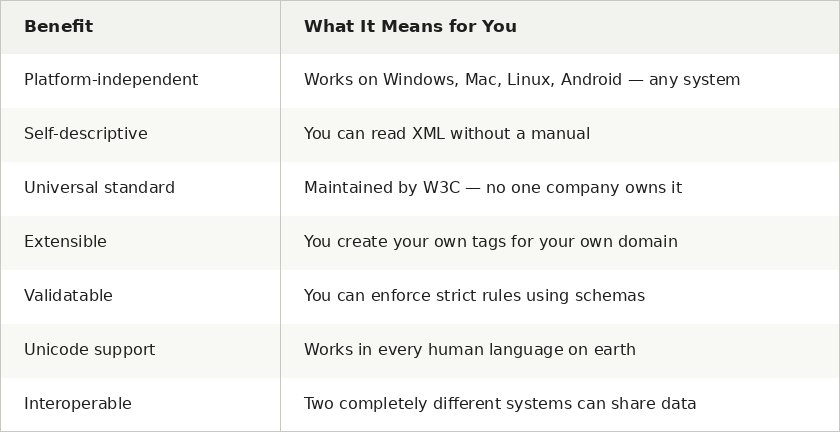
According to EBSCO’s Research Starters:
One of XML’s key advantages is its platform independence, enabling data sharing between different programs and devices, regardless of their underlying software or hardware.
XML’s Limitations — Let’s Be Honest
No technology is perfect. XML has real weaknesses:
- Verbose: XML uses a lot of characters. A simple value like 42 becomes
42 — much larger than needed. - Cost of storage: The additional text increases the file size and the need for bandwidth.
- Not suitable for large datasets: Large XML documents take up time and memory when being processed.
- JSON dominance: In contemporary web services, XML is outdated. Instead, JSON is more concise and quicker to process. Most REST-based web services today rely on JSON.
No technology is perfect. XML has real weaknesses:
- Verbose: XML uses a lot of characters. A simple value like 42 becomes
42 — much larger than needed. - Cost of storage: The additional text increases the file size and the need for bandwidth.
- Not suitable for large datasets: Large XML documents take up time and memory when being processed.
- JSON dominance: In contemporary web services, XML is outdated. Instead, JSON is more concise and quicker to process. Most REST-based web services today rely on JSON.
As GeeksforGeeks notes:
XML syntax is redundant or large relative to binary representation of the same data. The redundancy in syntax causes higher storage and transportation cost.
XML vs JSON — The Modern Reality
But if XML has all these capabilities, why is there so much hype about JSON?
Well, because JSON is smaller, simpler, and designed specifically for web applications and mobile computing. But for those situations where there is a need for thorough validation and complicated documents, XML reigns supreme — healthcare, financial transactions, government, publishing, and business applications.
Here’s how you can think about it:
- JSON is like a text message — quick, casual, perfect for chatting between apps.
- XML is a formal legal contract — structured, validated, unambiguous, and built to last decades.
Both have their place. The world runs on both.
The XML Ecosystem — A Quick Map
XML didn’t come alone. It brought a whole family of technologies:
- XPath — A language to navigate and find specific data inside an XML document
- XSLT — Transforms XML into other formats (like turning data into a readable HTML page)
- XSD — The schema language that validates XML structure
- SOAP — A protocol using XML for web service communication
- RSS — Your podcast feeds and news feeds? XML-based
Why Every Beginner Should Understand XML
You might be thinking: “I’m not going to become a developer. Why does this matter to me?”
Here’s why:
- It’s everywhere in tech careers — Whether you go into data analysis, product management, healthcare IT, finance, or software — XML knowledge gives you an edge.
- It teaches you to think in structured data — Understanding how data is organized is a fundamental skill in any modern career.
- It helps you read error messages and config files — Countless tools (Maven, Spring, Android, Microsoft Office) use XML. Being able to read it means you can troubleshoot without panic.
- It’s the foundation of standards — If you ever work with APIs, data standards, or system integrations, XML is the baseline language.
Where to Start Learning XML
If this article has sparked your curiosity, here’s your practical starting path:
- W3Schools XML Tutorial — The most beginner-friendly, free, hands-on tutorial
- MDN Web Docs (Mozilla) — Accurate, developer-grade reference
- Microsoft’s “XML for the Uninitiated” — A remarkably clear plain-English explanation
- W3C Official XML Page — The authoritative source
The Takeaway
XML has been quietly holding the digital world together for over 25 years. It’s in your hospital records, your bank’s risk systems, the news you read, the apps on your phone, and the files on your computer.
It solved one of computing’s oldest problems: how do two completely different systems share data without losing meaning?
It answered that question with elegance — using tags that any human can read and any machine can process.
You don’t have to become an expert in XML. But the next time you see those angle brackets —
They’re putting labels on the world’s data. One tag at a time.
Did you find this helpful? Share it with beginners in tech. A clear explanation of something they were too scared to ask about is the best gift you can give a beginner.
References
W3C — Official XML Page
Extensible Markup Language (XML)
Wikipedia — XML
MDN Web Docs — XML
XML: Extensible Markup Language | MDN
W3Schools — XML Tutorial / W3Schools — XML Use Cases
IETF RFC 3470 — XML in IETF Protocols
RFC 3470: Guidelines for the Use of Extensible Markup Language (XML) within IETF Protocols
O’Reilly — XML in a Nutshell
XML in a Nutshell, 3rd Edition
Toptal — JSON vs XML History
A Deep Look at JSON vs. XML, Part 1: The History of Each | Toptal®
ScienceDirect — XML Overview
EBSCO Research Starters — XML
Progress Software — XML Databases
Best XML Database Banking, Healthcare, Media
GeeksforGeeks — XML Full Form
OVHcloud — What is XML?
https://www.ovhcloud.com/en/learn/what-is-xml/
XML Is Everywhere — You Just Never Noticed It was originally published in GoPenAI on Medium, where people are continuing the conversation by highlighting and responding to this story.